Probability, in plain English, using the games on this site
You do not need maths to enjoy dice or keno, but a little of it explains why the games feel the way they do — and why a hot streak means nothing about the next round.
Probability is just counting
Roll two dice and there are 36 possible pairs, each as likely as any other. Six of those pairs add to seven, so seven arrives once every six rolls on average. One pair adds to twelve, so twelve arrives once every thirty-six. That is the entire calculation, and everything else follows from it.
Odds are the same information written differently. A one-in-six chance is “5 to 1 against”, because there are five losing outcomes for every winning one. When a game pays 5 to 1 on that bet, it is paying exactly what the chance is worth — which almost never happens in a casino, and does not quite happen here either.
Independence, and the mistake everyone makes
Dice have no memory. Nor do shuffled cards, nor a keno draw. Six low totals in a row does not make a high total “due”, because the next roll is generated from scratch with the same 36 possibilities as always.
This is the gambler's fallacy, and it is remarkably persistent. On this site it costs you nothing, which makes it a decent place to watch it happen: back the same total twenty times and count how often the pattern you expected fails to arrive.
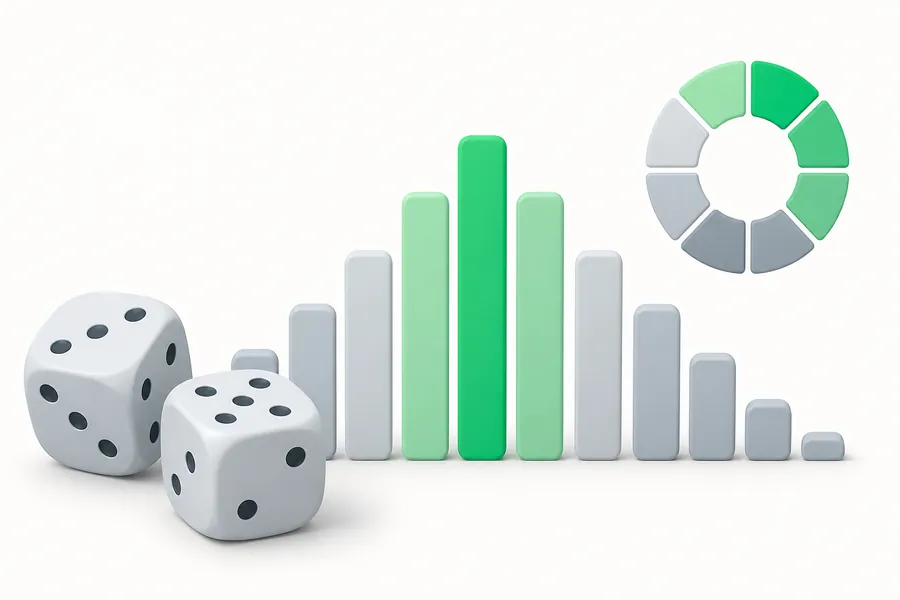
The same idea across three different games
Each of these comes straight from the games on this site, and each is worked out the same way: count the outcomes that qualify, divide by the outcomes that exist.
| Question | Working | Result |
|---|---|---|
| Two dice totalling seven | 6 of the 36 pairs | 1 in 6 |
| Two dice under seven | 15 of the 36 pairs | 41.7% |
| A dealt royal flush | 4 of 2,598,960 five-card hands | 1 in 649,740 |
| A dealt pair of any rank | 1,098,240 of 2,598,960 hands | 1 in 2.4 |
| Six keno numbers all drawn | 20 numbers drawn from 80 | 1 in 7,753 |
| Ten keno numbers all drawn | Same draw, ten marked | 1 in 8,911,711 |
Keno figures are rounded to the nearest whole number. A quarter of the board is drawn every time, so on average you catch a quarter of what you mark — two and a half numbers on a ten-spot ticket.
House edge, without the jargon
A game's edge is the gap between what a bet is worth and what it pays. Calling an exact total of twelve on two dice is a 1-in-36 shot, so a fair price would be 35 to 1. Coral Dice Duel pays 30 to 1. That gap, repeated over hundreds of rolls, is why the balance trends downward.
Blackjack works differently. The dealer's fixed rules and the 3-to-2 blackjack payout are set, but your decisions move the result, which is why it rewards learning in a way the other three games do not.
Short runs prove nothing
Averages describe the long run, and the long run is much longer than most sessions. Twenty rolls can easily produce five sevens or none at all; both are ordinary. The wider the sample, the closer the results sit to the underlying probability — a result known as the law of large numbers, and the reason no run of luck ever changes the maths beneath it.
What none of this gives you
- Not a system. No betting pattern changes the odds of the next round. Doubling after a loss only changes how fast the balance moves.
- Not a prediction. Knowing seven appears once in six rolls tells you nothing about the roll in front of you.
- Not an edge in a real venue. These pages explain how the games work. That understanding has no cash value, here or anywhere.